News

February

2026

February 2026 LINK Article

We have recently been contacted by the granddaughter of H D Smith – the last headmaster of Cottesmore Central school which stood on what is now the Wenton Close estate. Her mother Molly has died aged 101 in 2022 and kept memorabilia from Mr. Smith from his time at the school. This includes several cups, pictures and an album. We are arranging to zoom and arrange for collection of what we hope to be exciting articles of historical interest in the education of Cottesmore.

Some years ago we were contacted by the daughter of an evacuee who lodged with the Smiths from 1939 to 1943. He recalled Molly who he regarded with much fondness. It is such a shame that Mr Smith’s daughter could have contacted or even met her father’s “big sister” had we been made aware some years ago.

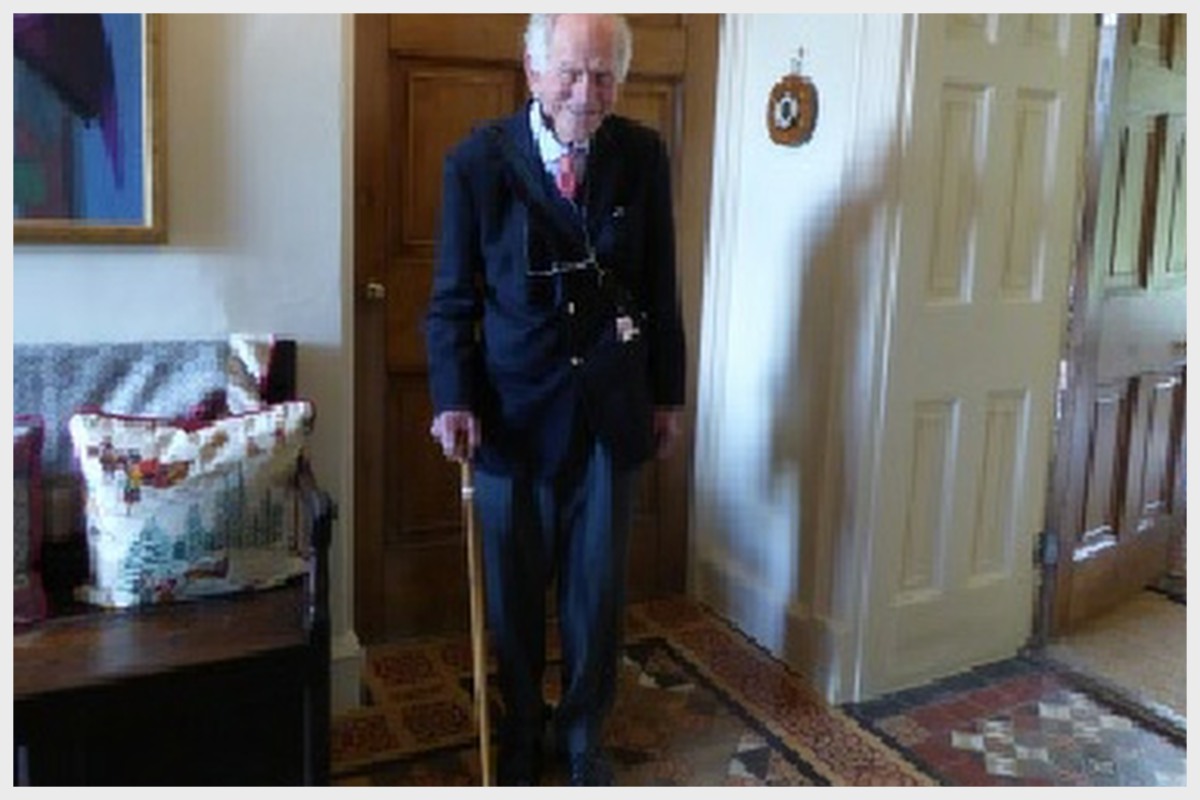
Molly’s photo is below from which the buildings of the school can be distantly seen.


Our website – Cottesmore the living village has had a makeover so please visit it for more fascinating information on where we live. 

 If you are interested in joining the group we meet on the second Wednesday of each month at 7.30pm and should be delighted to welcome new members. For any information, please contact Chris Whitton on 01572 812016.

February

2025

At the beginning of the new year,CHAG members have been welcomed by the headteacher of St. Nicholas C of E primary school to help with a history project. The year 4 pupils project for study is "Education in Cottesmore in the last 200years".

Working with the children we have sought to find answers to the following questions:-

How many schools has Cottesmore had during this time?

What was different/same about the schools then and now?

Our website,collections of photographs and various other sources have helped to gather much knowledge and understanding of the lives of children and teachers during this period of history from 1820-1964.

Starting with the Village School in the Rectory garden( now the Tithe Barn ), to the school in the Leas, the Central School and the schools on the Military Camp.

The children also realised that history and facts can sometimes become muddled over time , that names change especially over many years. An example of this was the school in the Leas which was in existence for over a hundred years, consequently had many name changes ranging from :-

The Mixed school

Junior school

Cottesmore Primary School

St. Nicholas C of E primary school.

The influence of Acts of Parliament determined the curriculum, the buildings and the age of compulsory attendance.

This project is always a learning curve especially for the adults involved and to the children an insight into life in times gone by.

Significant also, for all concerned was to learn how difficult it must have been to seek to educate with none of the facilities we have today. (1953- piped water introduced in Cottesmore , 1958-modern sewage installed in the village)

The Central School (once in the area of Wenton Close) and subsequent changes in education with the introduction of of the 11+ will be high lighted but the 8to9 year olds will be primarily concentrated on the history of their school and its development from 1964 .

The project continues each Friday afternoon until the Spring break.

A time for all ages to share the rich history of our village .


2024

February

We have recently been sent a copy of the Cottesmore Chronicle , issued in March 1940 at the cost of 4d(old pence) equivalent to less than 1/2p today.

The patrons included the headmaster of Fleet Central School , Mr H. Millward, whose 250 pupils were evacuated to this area including 50 at Cottesmore Hall – now occupied as houses in Cresswell Drive and Jubilee Gardens.

The school succeeded in integrating into the community, living up to their motto of “Non sibi sed toti” - service not self.

The Chronicle includes a “Gossip Column” which is more a guide to correct living, part of which refers to ice skating and a certain young lady:-

“There is one amongst us, who apart from her other qualities, has an extremely affectionate nature. At least this is the only explanation of her conduct whilst skating. No doubt her dimples were particularly provocative.”

I leave the interpretation to you.

2023

November

They shall grow not old, as we that are left grow old: 

Age shall not weary them, nor the years condemn.

At the going down of the sun and in the morning

We will remember them.

Laurence Binyon 1914

We remember the brave souls who gave for our freedom.  The villagers of Cottesmore and those who came here too.  Our War Memorial, the Chapel in the Parish Church and the War Graves in the cemetery carry their names.  They are remembered on our village website too:  World Wars Introduction - Cottesmore History and Archaeology Group. https://www.thelivingvillage.co.uk

Cottesmore still hosts women and men who are prepared to fight for us.  Out of sight and out of mind at Kendrew Barracks and perhaps regarded like Tommy Atkins was a century or more ago.   They too deserve our thoughts, admiration and gratitude.

For it's Tommy this an' Tommy that an' "Chuck him out, the brute!"

But it's "Saviour of 'is country" when the guns begin to shoot.

Rudyard Kipling 1890
October

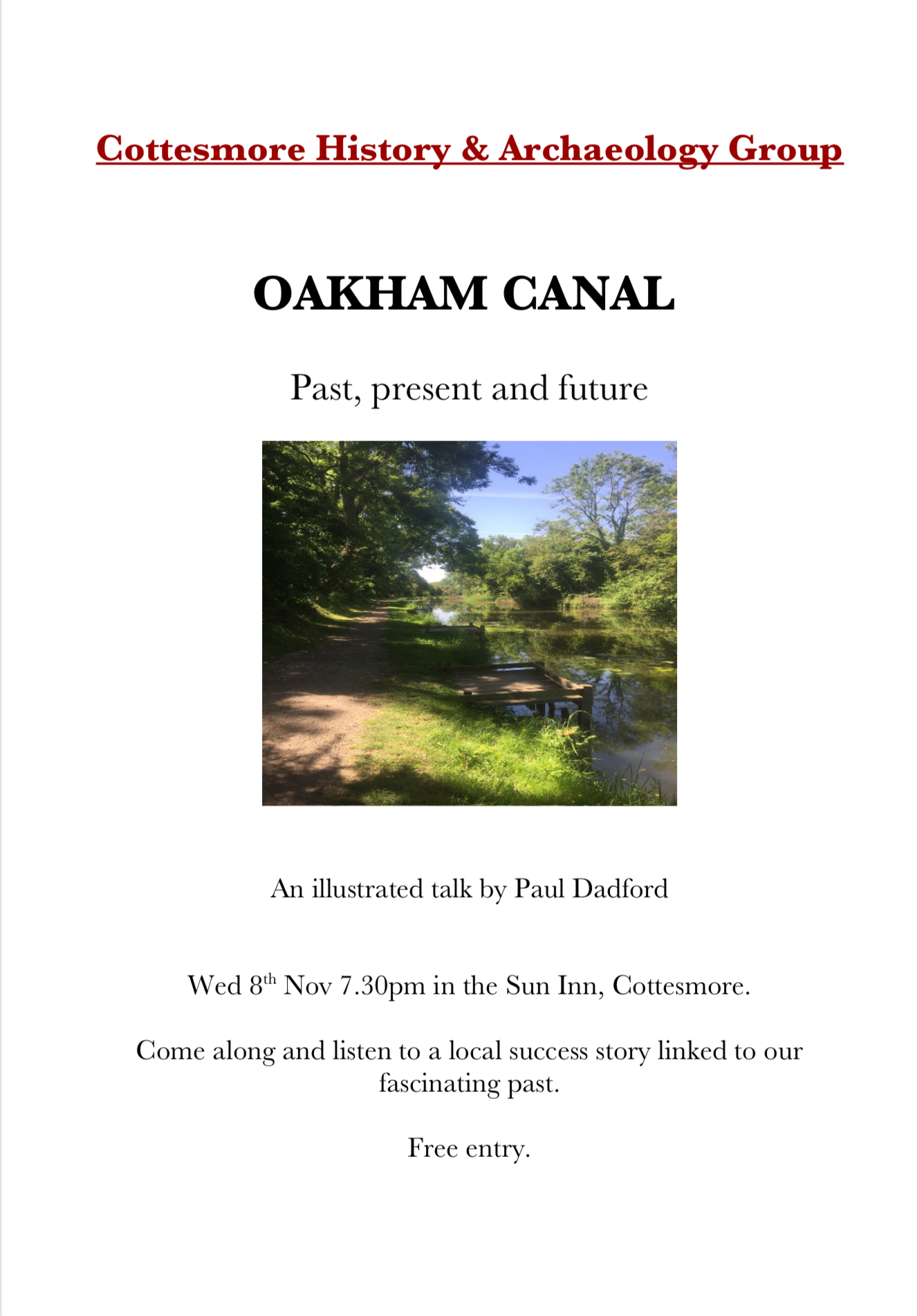
Have you enjoyed a peaceful walk on the Oakham Canal at Langham, with its rich display of wildlife, flora and fauna?  Come to learn of its history, restoration and hope for the future with Paul Dadford a the Sun Inn, Wednesday 8th November at 7.30pm.

September

In November 2019 our group enjoyed a presentation on the Oakham and Melton Mowbray Canal by Paul Dadford. This opened in 1802 and was never a financial success, suffering from an inadequate water supply and was closed after 45 years, being bought by the Midland railway. Locally it ran from Market Overton to the Cottesmore Road near the Rutland Railway Museum before arriving in Oakham.

Since 2019 a lot of you will have enjoyed a walk on a stretch of the canal near Langham and Ashwell which is a credit to Paul and the Melton and Oakham Waterways Society.

We are delighted to announce that Paul will be returning to the Sun Inn, Cottesmore on Wednesday November 8th to update us on the progress made in the last 4 years.

Full details will be in the November Link.

August

A Forgotten Cottesmore Chapel.

In 1870 a local preacher gathered a group of worshippers on the Green in Cottesmore, and as their numbers grew over the years there became a need for a permanent place of worship. In 1889 an old thatched cottage on Clatterpot Lane became the Primitive Methodist Chapel and was opened officially on January 1st 1890. The opening was featured in the Lincoln, Rutland and Stamford Mercury who reported that after a sermon was preached a public tea was held and attended by over 100 people. The chapel provided a meeting place for agricultural workers and poorer villagers who broke away from the more traditional Methodist religions. Their chapels were much plainer designs as can be seen by the current building converted to a house in the 1970's.

In 1903 the building was rebuilt to be used as a chapel and Sunday School, and it was specified that it should be undenominational. The lease was granted by the Earl of Gainsborough at a rent of £3, paid in two half yearly instalments and the cost was specified as £180. All the trustees were local people, some of whose descendants still live in the village. The building materials and methods were strictly controlled and once finished the building was to be surrendered to the lessor, Earl Gainsborough. On completion a Sunday school was started and became popular with local children.

In 1912 the chapel was registered for solemnising marriages and the first one was performed in December 1912.

During WW2 American airmen stationed at RAF Cottesmore used to visit the chapel bringing sweets for the children of the village. The chapel finally closed in 1964, remaining empty until its conversion to a house in the 1970's. It remains a family home, and a few remainders of its history can still be seen inside the house.


July

We are delighted that copies of the new updated Cottesmore Round are now available.

As advertised recently in The Link, this new version includes details of local businesses as well as interesting historical, architectural and pictorial facts and will be of interest to both residents and visitors.  It is in booklet form and includes a detailed map to facilitate an easy tour of the village.

We intend that these will be available shortly at The Village Shop, The Fish and Chip Shop, The Sun Inn, St Nicholas' Church and Eassons Garage.

Please pick up a copy - they are free!

June

As advised earlier we have spent a long and interesting time in updating and expanding the Cottesmore Round, which, even in its original form, was one of the best publications around. The new version which includes details of local businesses as well as interesting historical, architectural and pictorial facts has gone to print and will be available shortly. It is in booklet form and includes a detailed map to facilitate an easy tour.
These will be available shortly at local businesses, details of which will be shown on the Cottesmore Times website which is a part of Facebook or on our own website www.thelivingvillage.co.uk

If you are interested in joining the group we are meeting at the Village Hall on the second Wednesday of each month at 7.30pm and should be delighted to welcome new members. For any information, please contact Chris Whitton on 812016.

May

During the last school term the group has been privileged to work with Mr Daniel Alfieri, the headmaster of St. Nicholas School, and the year 4 children on a project " The history of education in Cottesmore".

We walked round the village and viewed the sites of previous schools noting dates and other relevant information.  The children then collected and sorted the facts on the history of the school of which there was so much that, with the lead of Mr Alfieri, we were able to concentrate on one element - the development of the current school building from 1964 to the present day.  This took place in three stages, a record of which was recorded by the pupils.

It is the hope of the headteacher that this project will be developed each year by the year 4 children.

During the next school year they will study the development of the school in the nineties and concentrate on events, celebrations and people connected to the school, including any of their parents and others who attended.

We are happy to continue to be involved and wish to thank Mr Alfieri and the school for allowing our participation in this interesting project and look forward to its next stage.

April

One of our latest projects gives us another opportunity to involve ourselves with St.
Nicholas School and their curriculum.
The subject is “The history of education in Cottesmore” in conjunction with Year 4
pupils. We have walked round the sites of former schools in Cottesmore, having
shown the children pictures from our website and following a route on the village
map.
Using pictures the children made notes, and listed the differences between the
former mixed school in the Leas and the new school built in 1964 on Mill Lane.
The following week they walked round their school and noted compared the
differences and just how far the school had developed during that time. The study
is continuing.
Shortly we shall be printing the new enhanced version of the Cottesmore Round, a
detailed guided tour of our village including maps, photographs and historical
information. Next month’s article will give you details of how you can get your
copy.

January

On the local Facebook site, a former village resident posted that she was clearing out her late mother's effects and found some handwritten memories from a Miss Merry which she photographed and added to the site.
One of the stories was about a little girl, Gill Broome, who fell in love with a donkey on a trip to Skegness and persuaded her father to bring it home to be cared for in Cottesmore for the winter. Said donkey was put into the paddock behind the Sun Inn, but decided he would rather explore, and Gill's father spent a lot of time that winter rounding it up.Apparently it also kept a lot of people awake by braying in the night. I suspect the donkey never came back to Cottesmore. As a result of this article another former resident then posted a photo of the donkey with its temporary owner. Does anyone else remember it? The full article and the photograph will appear soon on the CHAG website.

LINK ARTICLE Nov 2022

Another snippet from the memories of Mis Merry concerns the Lonsdale family. Lord and Lady Lonsdale lived for many years at Cottesmore Hall and always travelled in yellow coaches as that was Lord Lonsdale's favourite colour. He was known as “The yellow Earl” and of course founded the present day Automobile Association, hence the association's yellow livery. They sat in “their” seats in St Nicholas' Church on Sundays. Maids from all the large houses in Cottesmore would also attend church and sit in specially designated pews. There were 6 maids serving at the Old Rectory and they, along with others would be picked up from Oakham Station by pony and trap driven by Hedley, Miss Merry's brother and taken to church.
The full account of Miss Merry will soon be on the website of CHAG, www.thelivingvillage.co.uk,

2022

Talk by Tony Martin

Click here to see details

Cottesmore Link article September

As you will have seen the Cottesmore Allotments are named, appropriately, after the “son” of Cottesmore, Richard Westbrook Baker who was famous for inventing the innovative Rutland Plough.

In the 1830s, stimulated by a growing demand for food from a growing population, farmers introduced new fodder crops and other animal feeds and Richard Westbrook Baker was at the forefront. His Shorthorn cattle were the pride of Rutland, being widely seen at shows and demonstrations. His bulls, rams and boars were made available to be used on local farms.

The Rutland Show Society was started in 1831 of which he was Steward and many of the winning animals went on to London to be shown at Smithfield. He himself had many successes notably winning the Gold Medal in 1837 for the “best beast in any class” with a Shorthorn Heifer and again with a Shorthorn Ox in 1860.

Rutland History Society open evening July

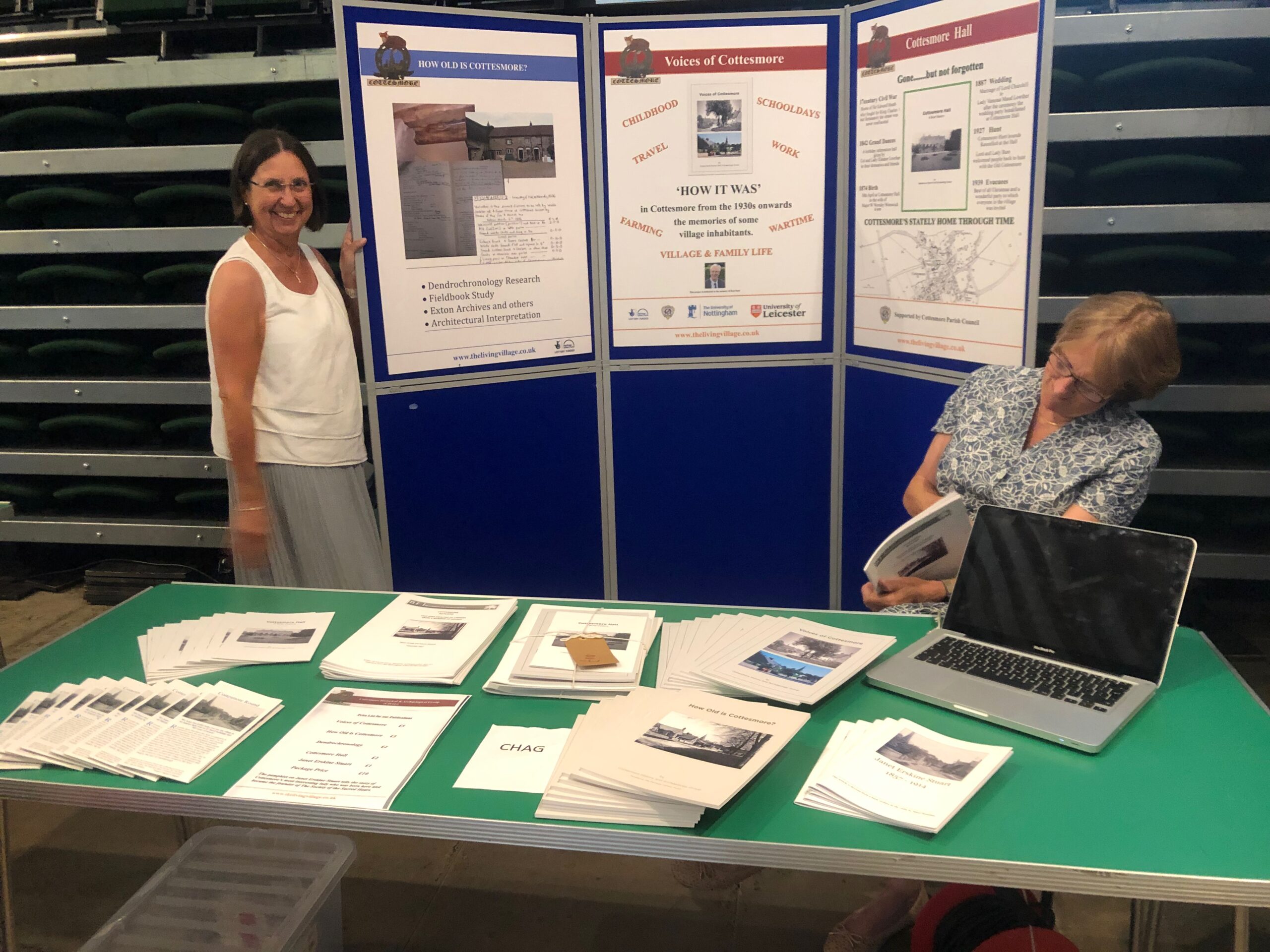
CHAG attended the Rutland History Society open evening at the Rutland County Museum on 14th July, where we had a stall showcasing our publications.  It was an opportunity to meet other local societies and we sold several of our publications.
Cottesmore Link article July

We have received an interesting tale from Richard Francis about the eldest daughter of Alfred Cattell who was born in Cottesmore in 1857 and later became Lord Mayor of Sheffield.
Gladys Matilda Cattell was born in 1884 and in 1914 found herself in Russia as a governess to an aristocratic family. In 1918, forced to leave during the Russian Revolution, she journeyed by train from Moscow to Vladivostock, a distance of 5700 miles with Sarah Josephine Dowling from whose great niece we have also heard. In Vladivostok she met Lyndall Crossthwaite Pocock who was working for the Red Cross. The two girls travelled to Yokohama in Japan where ocean passenger lists show they travelled to Canada on the “Empress of Asia” and thence from New York to Liverpool on the Cunard ship “Orduna” in May 1918. We believe she had met up again with Lyndall in New York and they married in Woolwich, Kent and settled in North London, having 4 children.

Cottesmore History & Archaeology Group (CHAG)

2020

2020 April

Sunday 26th April 2020

We have recently updated and expanded the item on Cottesmore Hall, which appears in the “Buildings” section of the website.  It remains as one of our main projects to research further the history of the Hall, which was built in the 18th century and demolished in 1974.  We have various documents concerning the Hall, and various photographs, not to mention the memories of villagers who can still remember it.   We hope in due course to publish a summary of the results of our researches.

Needless to say, if anyone looking at this site feels they have information that could be of use to us in our project, we would be very happy to hear from them!

2020 March

Monday 20th March 2020

New publication, Voices of Cottesmore.

The recorded memories of how it was in the village from 1930s onwards.

Available from Cottesmore Village Stores & Post Office £5.00.

Review from The Village Link Magazine April edition.VOC Linkreview

2018

2018 July

Wednesday 10th October 2018

A talk to be given by Alan Crosby Author and editor of the Local Historian magazine.

The Earls of Longsdale at Cottesmore and Barleythorpe

The Lowther family, Earls of Longsdale, were the richest family in Cumbria but preferred to live and hunt in Rutland. What is their story? 2.30pm. The Sun Inn, Cottesmore use the contact page to apply for your free ticket.

2018 January

The latest CHAG project has been completed the results of which can be seen in the new section 'How Old Is Cottesmore'. As a result of HLF funding we were able a few dendrochronology study of a number of buildings in the village together with their social an economic background.

On the new tab you can find connections to video of the plus two books showing the process and the results.

Other outputs will be released soon.

2016

2016 October

Following months of preparation we are prepared for the first of 2 presentations of “How Old is Cottesmore”. This will take place between Midday and 3pm on Saturday 5th November in the Village Hall, Cottesmore.

The exhibition will show photographs of some of the older village buildings with explanations of how their age has been calculated and interesting facts for each property.

Both Cottesmore schools have been involved, visiting 2 properties, preparing their own views and their contributions will be included.

This is an opportunity for attendees to see details of some of the buildings which have defined the history of their village in an easy informal way.

2016 September

Preparations are going well for our November presentation of “How Old is Cottesmore”. This will be the first of two and will take the form of an interim report on each of the properties selected.

The exhibition will show an external photograph, a plan and brief details af an architectural fact. Also included will be a text of some interesting information for each property eg there could be a ghost or some famous or infamous historical character lurking in the depths of a Cottesmore property.

August 2016

In June this year the year 6 pupils of the two Cottesmore schools – Millfield Academy and St. Nicholas Primary met at the Village Hallwhere they were introduced to Dendrochronology They worked in groups to count the rings on slices of tree trunks to calculate their age.

This was the start of a week’s activities which included visits to the Church and the Grange where different schools worked on separate projects. Several drawings were done, one of which was framed and presented to the Grange. The work was later mounted, in preparation for part of our presentation to be held in the Village Hall in November to which the community will be invited.

July 2016

This month we had the pleasure of a guest speaker – Dr. Vanessa Doe, who gave a fascinating talk on some aspects of the history of Cottesmore and Greetham, illustrated by a map of 1619. This map detailed the various properties in the villages and the highways connecting them. The route of the Great North Road (A1) was shown, which was little more than an unenclosed track for most of its route through our part of the county.

The talk also included some old photographs of Cottesmore, the identity of some of which required some thought and imagination. The grandeur of Cottesmore Hall and Cottesmore House was shown with sad contrast to their demise due to lightning and subsequent fire.

June 2016

This month saw the Group’s involvement with the Year 6 children of St Nicholas and Millfield Academy schools in the Dendrochronology project.

Both schools visited the Church and the Grange where the principles of tree ring dating were explained together with details of the origins of the buildings and their progress through the centuries. Interesting facts were included such as when the church was Roman Catholic, the priest spoke in Latin whereas the majority of the congregation would speak Anglo-Saxon and that neither language would be understood by the children nowadays in any case.

The schools are now undertaking a separate project on each property comparing how developments in Cottesmore were taking place alongside the rest of the country. They will also study interesting occupancies of the properties. The intention will be for an exhibition/display to be produced demonstrating their involvement in the project.

May 2016

Our “How Old is Cottesmore” project progresses with the involvement of the 2 Cottesmore schools whose year 6 pupils have been invited to take part.

They will be introduced to Dendrochronology and be able to study the core samples taken from older properties in the village, together with slices of tree trunks. They will be able to count rings and estimate the dates and climate conditions of the samples.

The children will be invited to visit 2 buildings in the village and study their development over the centuries and compare the development with the rest of the country e.g when the church's chancel was extended in 1215 the Magna Carta was being signed by King John.

April 2016

We have been spending many months on a project called "How Old is Cottesmore" and on Saturday 16th April we gave our first presentation to members, invited guests and property owners.d

There were visual displays of properties being investigated, with external photographs and floor plans of the buildings.

Nick Hill of Historic England has kindly given his time voluntarily for this project and gave a fascinating architectural explanation revealing how the windows, roof, doors and layout were good examples of the era of construction.

Fir Tree Farmhouse is a well built farmhouse of stone and thatch. The original house having had a "standard" three room plan of which the hall and parlour have been tree ring dated to 1709. The kitchen, built at the same date, has an older beam dating back to the late 16th century and was probably reused from an earlier house on the same site. The converted outbuildings can be traced back to the early mid-19th century but the roof structure in part is original. One of the chimney stacks is also original being stone-built with a chamfered plinth and a stone slab stalk. Most of the original roof structure survives being constructed of oak with ash rafters.

In 1909 Lloyd George, the Liberal Chancellor of the Exchequer, needed to increase taxation to fund old age pensions. He passed the Finance Act, which required a survey and valuation of all land and property in the UK.

Four types of record were produced for each Parish, one of which was the Surveyor Field Book. This gave information of location, ownership, tenancy, building and land descriptions. We now have copies of the Cottesmore Surveyor Field Books and can match these with the properties being investigated.

March 2016

We have been involved in a project to renovate the St. Nicholas' Church Rectors Board and it has been interesting to see just how far back records go. The first "Incumbent" as they were originally called was Robert De Hertford who was designated Chaplain for 2 years and then became a "Warden of the Hermitage of Cottesmore" for 1 year in 1229.

There are also some more flamboyant names such as Master Nicholas De Bascho, possibly from Kingston, Jamaica and Robert of Saint Bridget, who served the parish in 1230 and seems to have taken part of his name from Saint Bridget (one of Ireland's Patron Saints from Kildare).

February 2016

Jane Greenhaigh gave an interesting presentation for our "How Old is Cottesmore" project, commencing with a copy of the 1913 Valuation Office plan which shows some of the 116 Cottesmore "land parcels". Over 70,000 Field Books were prepared for this country and these reveal the address, owner, occupier and full details of the property, land and its value and rateable value. The surveyor also gave an opinion on property condition such as "shoddy". It is sad to see some buildings described as "hovels" i.e. squalid or poorly constructed.

Our next action will be to link the Field Book plans to modern-day addresses and obtain full details of the occupiers from the 1911 Census to build up a full scenario of particular Cottesmore addresses. These will be published on our website later in the year.

January 2016

Our "How Old is Cottesmore" project continues well and we shortly hope to be able to consolidate information gathered with the original village plans and their present day addresses.

We have now been able to analyse the extent of access on our website and are pleased to see an average of about 300 "unique visitors" per month. What is interesting is the variety of the country of the visitors and these include a significant number from The United States, Germany, Russia and Israel. The most popular "hits" would appear to from genealogists researching family records from the parish records of baptisms, marriages and burials but there has also been interest in the list of Rectors and the Village Welcome Board amongst others.


2015

December 2015

Our December meeting comprised a celebratory buffet at which we received encouraging news of the number of "hits" on our website.

At this time of year it is interesting to know that at Christmas 1942 the main excitement was the performance of Aladdin by the evacuees. This was staged in the Junior School down what was then known as "Back Lane", now The Leas. The Sun Inn provided a stage of table tops supported by empty beer bottle crates. The theme song was "Boom, why does my heart go boom?" for those of you who may remember it and the magic lamp was an oil can used for oiling binders in the harvest fields. This was polished down to it's brass casing so it shone like gold. There were very few opportunities to see live shows during the war years so this was an occasion to remember.

November 2015

Our main 2015 project of "How Old is Cottesmore" progresses well. Early results, using tree ring analysis (Dendrochronology) has revealed three properties where the date at which the timber used in the building was felled can be estimated at being in the 16th century, one being possibly as early as 1500.

We have visited the Records Office at Kew to obtain many details including those necessary to identify the "plot" numbers corresponding with modern day addresses.

Other reports include school inspectors reports dated 1927 and 1932 for Cottesmore Central School which was situated on what is now the Wenton Close estate. The first report was quite unfavourable revealing the presence of rats and rabbits as well as one unsuitable teacher.

October 2015

To assist us with our main 2015 project of "How Old is Cottesmore" we enjoyed a presentation from Nick Hill of Heritage England on the architectural development of houses in Rutland, illustrated by photographs. These showed that, from the early 17th century, construction was typically of ironstone or limestone block. Incorporated were stone mullion windows, many of which have date stones as a feature and some include the initials of the family of the time. Doorways were typically Tudor Arch up to the mid 17th century, changing to Renaissance style thereafter. Roofs would be either straw or Collyweston slate, dependant on the family's wealth. Chimney stacks by their very nature have not survived well. Internally, there would have been large stone square fireplaces changing to classical mouldings as the century progressed.

In the 18th century there was a move away to stone framed or timber windows as the development of glass technology progressed.

We now have some further guidelines to continue with our project.

August 2015

Our main project this year of "How Old is Cottesmore" is developing as four properties have been visited for dendrochronology purposes. Samples of the wood in the beams have been taken and another five are scheduled for the same process by September/October. These will be analysed for computerised tree-ring dating and the results given to us. The project will continue using the services of a Leicester post-graduate student who will collate information relating to the properties and their occupants. Architectural details and ground floor plans will be produced to provide a comprehensive description and history of these properties, the oldest in Cottesmore.

We have been fortunate to have received the original of the Military Honorary Discharge of a former resident of The Grange, Cottesmore. This was Lieutenant F A Roughead who was born in Edinburgh in 1893 and died in Leicester in 1977. He suffered shell-shock in World War 1 and was invalided out of the 17th (Duke of Cambridge's Own) Lancers. He continued to live at The Grange for 20 or so years supported by some of the villagers and is remembered in Bernard Harper's book "The War Years of my Youth" as a giant of a man with reddish short-cropped hair, most feared by the village children. This was probably due to their winter sledging in the grounds of The Grange which made enough noise to prompt Lieutenant Roughead to charge out of the house with dogs and shotgun threatening to shoot them.

For those of you who wish to read more, please look at The War Years of My Youth document link in the Around The Village/The Sun Inn section of Buildings.

July 2015

The Group has been awarded a grant from English Heritage for a new project "How old is Cottesmore and how has it developed". The project will concentrate on 8 or 9 buildings in the village including the church and the Sun Inn. Through the use of tree-ring dating (dendrochronology) we hope to find the exact date when these buildings were built and how they developed to be what we see today. This work will be backed up by an architectural inspection and the story of their inhabitants. The end result will be a historical presentation in a small book to each occupier plus one for the village. From an educational point of view we hope to involve the two local schools and encourage their knowledge of how the village gas developed into what it is today. More information will appear here: How Old is Cottesmore

June 2015

Our Annual General Meeting took place at which our notable activities during the preceding year were summarised.

These included:

  • Participation in the World War 1 event at the Kendrew Barracks
  • Visit of The Nuns Of The Sacred Heart
  • The Village Show
  • Our Christmas Dinner at which Peter Liddle MBE spoke on "Roman Rutland".
  • Successful application for funds and progress made for restoration and conservation of the Rectors' and Church Charity Boards.
    Visits from Tommy Coggan and Shirley Smith M.B.E for their reminiscences of Cottesmore.

The present Group officers were re-elected.

Our monthly meeting centred on the forthcoming Dendrochronology project and a special meeting of those involved including the experts and occupiers of the properties selected which include The Sun Inn and St. Nicholas' Church.

April 2015

April's meeting reviewed the progress of our 2015 projects including the Dendrochronology dating proposals for certain village buildings. We are also pleased to report that the project to conserve a board in the St. Nicholas church which records an ancient charitable donation has commenced thanks to funding having been received.

We have obtained copies of some ancient Ordinance Survey maps dated 1884, 1902 and 1931 as well as one dated 1614 for exploration of ancient pathways and perusal of the village in its "previous lives".

Welcomed to the meeting was Shirley Smith MBE who is one of Cottesmore's senior residents and who had some interesting tales to recount of our village life.

We are excited about a major addition to our website of a diary written by Bernard Harper entitled "The War Years of My Youth". Mr Harper was the son of the "Sun Inn" publican at the outbreak of the Second World War and wrote a fascinating journal describing the pub, the village, its buildings and personalities at that time. As might be anticipated the pub had its own ghost and the village its own special characters including the Cheetham family billy goat which was capable of terrorising all and sundry when he escaped. The sound of gunfire invaded the village every 11th of May with the annual Rook hunt organised by the Reverend to ensure the numbers were kept under control. Rook pie became a Sun Inn speciality at that time. The journal progresses to describe Cottesmore during the war and we shall be retelling other stories in future articles, including boys' bomber chases and a remarkable meeting at Arnheim bridge.

March 2015

Dendrochronology, our proposed investigation into the age and history of certain interesting and old village buildings is moving forward with the agreement of potential property owners.

Examination of Parish records has uncovered a request in the 1980s for restoration of The Cottesmore Village Green which stood in front of The Sun Inn. The Village Green was the subject of surprise removal one Saturday morning in the 1950s and replaced with tar-macadam for the present parking area. We do have a picture of The Village Green from the side but would be interested to see any other views or receive any comments.

It has been learnt that during the Millennium Celebrations it was planned for a wall hanging to be made of village scenes to be mounted in the north door of the church. Does anybody know if this was done and of it’s present whereabouts?

Tommy Coggon and his wife Gwen were invited to our meeting to give some recollections of his life in Cottesmore. Tommy was a boy originally living in Rotherham in 1941 when bombs were dropped at the top of his street and it was considered safer for him to live with his grandmother in Cottesmore where he has lived ever since. His reminiscences were fascinating, covering topics such as the village buildings, village characters, the old Central school, life as a choirboy and pumps, ponds & water courses in the village. He has many memories of The Sun Inn including that the landlord knew the birthdays of all the village boys and welcomed them with a free pint on their 18th birthday having thrown them out beforehand.

February 2015

The Church Charity Board Restoration grant is progressing and conservators have been asked to quote. Rutland museum have provided a list of suitable people.

The Village Feast Week records have made references to a video, photographs (a competition and an archive of the village in 2000) as well as a wall hanging (formerly in the Church).

Dendrochronology, Ron had a lot to report and there was much discussion on how the project could be managed to spread the load, involve everyone and disseminate the information between ourselves and it was thought that one of our meetings in the near future should focus entirely on getting to grips with this project.
Ron and Jane had a very helpful meeting with the people who did

Much has been learnt from the Lyddington Dendrochronology Survey. The Lyddington History Group produced a file for each property and have given us a sample to act as a template for our own findings. They also provided a map from the sixteen hundreds showing field names in Cottesmore which can be directly compared to a map from 1850.

January 2015

For some time we have been trying to obtain further information on Cottesmore Central School which was located on what is now the Wenton Close estate. We have now discovered that log books for the school are on an Archive site and can be perused for interesting contents.

Saint Nicholas' Church, Cottesmore has been in existence since the 13th Century and we already have a full list of Rectors dating back to 1227AD. Many of these have fascinating names such as Master Nicholas De Bascho and John of Londonthorpe. Some served for a considerable period. John Barry M.A., for example, was the incumbent from 1617 to 1660 and Nicholas Onley for an even longer period of 55 years , commencing in 1670. Charles Edward Ellwood who started his tenure in August 1888 was a member of a well-known Cottesmore family. We hope to discover further details of interest on some of these Rectors and suitably commemorate them.

We also hope to explore the history of some of the older village buildings such as the Sun Inn including the use of Dendrochronology to ascertain their likely construction date.


2014

July 2014

Since the beginning of this year the Club has been very active with a number of exhibitions, presentations and web updates. However there was an exciting discovery when a relative of a previous Sun Inn owner gave us a copy of a history of the Sun Inn and the Village written by the son of the then owner. It covered the period of the Second World War and so was of interest from a number of angles. Two copies are held by the Club and can be made available to residents of the Village. In it you will find many interesting anecdotes about the Village (although some people have given a different interpretation of events). We also rediscovered a tablecloth that had been embroidered with the names of all the villagers in and around 1939. Each person paid 1/-shilling and the sum raised went to buying a cupboard for the Church. The tablecloth was mad e by a nurse Walker, who came from the West Indies and whilst in Cottesmore lived at Fountain Cottage.

In February we gave a presentation to the Cottesmore Women's Institute. There was a lively discussion after the presentation and many new stories appeared some in conflict with each other.

New panels were made, two for the exhibition we were going to have as part of the First World War commemoration whilst a third was a new panel for Janet Erskine Stuart.

As 2014 was the 100th anniversary of the death of Janet Erskine Stuart this was an important year for the Society of the Sacred Heart and they held a weekend remembrance conference in Roehampton which include a pilgrimage to Cottesmore. About 80 members of the Sacred Heart came and conducted two services of remembrance. They were also able visit the old rectory, where Janet was born, by kind permission of the current owners.


Earlier in the year the great nephew of Janet, the Earl Castle Stewart and his wife the Countess were able to visit Cottesmore, and saw for the first time where their great aunt had been born and grew up.

After the main visit by the Sacred Heart we had another visit. This time from Brisbane where 15 ex-pupils from a Sacred Heart School were following the route of the development of the Church and Cottesmore was high on their list of places to visit.

In the same month we attended the commemoration exhibition at Kendrew Barracks with the Rutland Museum. It was a very successful day with thousands of visitors.


Currently we are in the process of developing an interpretation board, in conjunction with the Parish Council, which will be placed opposite the Church this summer. The art work is done and currently it is with the company who will be erecting it.

We have continued with recording local villagers and this process will carry on throughout the year.


Finally the summer dinner, including guests, had the pleasure of listening to Robert Tregay, and his partner, describing how their home, the Grange, was developed during the 19th century.  It was developed in three stages, the first being in 1811 with two further extensions built by Richard Westbrook Baker, who was the Steward for the Exton Estate. One of the most interesting features of the house was the vaulted ceilings built to support the flagstone floors of the upper rooms. It was supposed that this process was put in place to protect the records and any monies from being destroyed by a potential fire. The grounds also contained a Ha Ha, unusual for a house of this size.

We are looking forward to the second half of the year when we will be mounting further exhibition in Cottesmore and Oakham as well as continuing our research into Village life, in particular some of the families that have been here for 200 years.

If anyone would like to contribute to these records we would be delighted to hear from you. Just send us an email to the address in the contact page.

2013

October 2013

In the beginning of October we attended our first interactive presentation with St Nicholas School in the village which both the children and members of CHAG enjoyed enormously. This is part of an on-going programme at the school on the history of the village. Their questions were both interesting and surprising and most important of all great fun. We will be doing a similar exercise at the Cottesmore School on the Kendrew army camp in November. We hope this will lead to a greater collaboration between the two schools.

August 2013

The end of August saw the Village’s annual produce show and the Cottesmore History and Archaeology Group took the opportunity to put on an exhibition ‘The Living Village. The weather was against us but we were able to show our work which resulted in two more members joining the Group.

Work continued on the project and in particular we started on the web site.  We showed our exhibition at Gainsborough Court ,which is the local residential home, and was able to have an interesting discussion with the residents from whom we gleaned more information about the village.

The audio recordings from local residents continued and we hope to publish the result later on in the year in the form of a disk and they will also be available on the website. The recordings give an insight into village life over the last 70 years from people who were there.

July 2013

In July the village had a visit from the Society of the Sacred Heart as part of a pilgrimage ‘In the steps of Janet Erskine Stuart’, such an important figure in their church. 100 members of the society arrived and held 2 services in her commemoration. Next year, the 100th anniversary of her death, many more will.