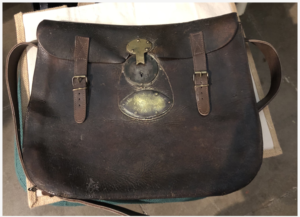
At the Rutland History Society open evening in July 2024, a visitor showed us an old leather satchel he had bought which had originally belonged to Sir Richard Sutton, a former Master of Cottesmore Hunt and a resident of Cottesmore Hall in 1842. This is a description of his connection to Cottesmore.
In 1819, he married Mary Elizabeth Burton (1797 – 1842), elder daughter of Benjamin Burton, of Burton Hall, County Carlow, Ireland. Benjamin Burton’s home was at Walcot House, Stamford, Lincolnshire. The marriage took place at St. Peter’s in Eastgate, Lincoln Their marriage produced seven sons and four daughters. Early in January 1842, the baronet was recalled to London from the hunting fields due to the ill health of his wife. She died a few days later. Later that year he accepted the Mastership of the Cottesmore Hunt. Lord Lonsdale, the previous Master, had been suffering from ill health and resigned the post. He sold his hunters and hounds and quit Cottesmore Hall, after which his hunt was named. Sir Richard took up residence at the hall, took over the stables and moved his large pack of hounds into the kennels. However, he almost declined the mastership because Cottesmore Hall may not have been available to him as a hunting residence. It was owned by the Earl of Gainsborough and his son, Viscount Campden, wished to occupy the house.
We have a description and valuation of the Hall made in 1843, which reads as follows:
“The property of the Earl of Gainsborough called a Mansion, value £4000. Premises called the Stable Yard adjoining or contiguous thereto, value £2000, and also the Stable Yard and premises situate west of the aforementioned house and Stable Yard and adjoining thereto, £1000.
“The mansion and premises adjoining are substantially built with stone and brick, with strong stone or brick party walls. The premises west are stone built, part thatched and part tiled, and consist of a groom’s dwelling beside stables and other premises as formerly occupied by the Earl and Hon. Henry Cecil Lowther.”
Over a period of eighteen years Sir Richard had developed his kennels and when he took on the Cottesmore country in 1842 he showed the men of the Midlands a pack of hounds which for symmetry and working qualities could not be bettered. The History and Gazetteer of Leicestershire and Rutland 1846 tells us that Sir Richard had 70 couple of foxhounds at Cottesmore kennels and a large stud of hunters. Later in life he revealed that he had spent almost £300,000 on his foxhunting activities.
During the period of his mastership the hunt became known as Sir Richard Sutton’s Hounds. His time as Master of the Cottesmore covered the seasons 1842-1843, 1843-44; 1844-45; 1845-46; 1846-47. 1 Perhaps the newly widowed baronet needed a change of scenery to get over the loss of his wife.
It was during these years that the post bag would have been used. At that time the post was brought to the postal towns by mail coaches and in some cases, where there were early railway links, by train. The mail was then sent out from the postal towns to the various villages, by messengers or letter carriers. The title ‘Letter Carrier’ was replaced by ‘Postman’ in 1883.
Wealthy and important residents would receive a lot of mail, as it was the only means of communication. We think this is where the mail bag came into use. It sorted the mail for Sir Richard, separated it and protected it from the weather.
Cottesmore’s postal town was Oakham and, during Sir Richard’s time in Cottesmore, the Postmistress in Oakham, Mrs Stimson, would send out the mail sometimes twice per day, to Cottesmore village Post Office, which was run at the time by Mrs Ann Lambert. Perhaps Mrs Lambert had the post bag in her office to fill and deliver to Cottesmore Hall. When Sir Richard had letters to send, the bag could then be returned to Cottesmore Post Office for stamping and sending on. This mail would have had the newly introduced Penny Black stamps, which were introduced in 1840. The postal service appointment books show that the messenger for Cottesmore from 1844 was John Berridge, a local man. The appointment book states that he had been recommended by Colonel Lowther. Col. Henry Lowther was the second son of the 1st Earl of Lonsdale, who held the Mastership of the Cottesmore Hounds, before Sir Richard Sutton.

Colonel Lowther was a Conservative politician, whose long political career saw him eventually become Father of the House. As an MP, it was extremely important that he had a trusted messenger to ensure the security of his mail.